Japan : Stamps [Theme: Pagodas | Year: 2007] : Colnect 📮

Easily manage your personal collection - Log In
Stamp catalog › Stamps (Theme: Pagodas, Year: 2007)
Kongō Sanmai-in Temple - Tahōtō (Pagoda)
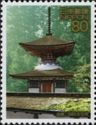
- Series:
- World Heritage (3rd Series) - 2: Kii Mountain Range
- Catalog codes:
- Mi:JP 4183, Sn:JP 2982i, Yt:JP 4025, Sg:JP 3554, Sak:JP C2005i-9, WAD:JP39.2007
- Themes:
- Architecture | Buildings | Forests | Pagodas | Religion | Temples | Trees | UNESCO World Heritage Sites
- Issued on:
- 2007-03-23
- Size:
- 28 x 37 mm
- Colors:
- Multicolor
- Watermark:
- No Watermark
- Format:
- Stamp
- Emission:
- Commemorative
- Perforation:
- comb 13 x 13¼
- Printing:
- Photogravure
- Paper:
- Phosphorised
- Gum:
- Ordinary
- Face value:
- 80 ¥ - Japanese yen
- Print run:
- 1,000,000
- Score:
- 59% Accuracy: High
- Description:
- CopyWrong
- Buy Now:
- 5 sale offers from US$ 0.32
51st Temple: Ishite-ji (Stone Hand Temple)
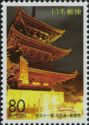
- Series:
- Cultural Heritage of Shikoku's Eighty-eight Temples
- Catalog codes:
- Mi:JP 4307, Sn:JP Z824k, Yt:JP 4154, Sg:JP-SHIK 75, Sak:JP R703k, WAD:JP188.2007
- Themes:
- Architecture | Buildings | Pagodas | Religion | Temples
- Issued on:
- from colnect.com
- Size:
- 26 x 36 mm
- Colors:
- Multicolor
- Watermark:
- No Watermark
- Format:
- Stamp
- Emission:
- Regional
- Perforation:
- comb 13¼
- Printing:
- Photogravure
- Gum:
- Ordinary
- Face value:
- 80 ¥ - Japanese yen
- Print run:
- 400,000
- Score:
- 77% Accuracy: High
- Description:
- This stamp was also issued by Ehime, Kagawa, Kochi and Tokushima Prefectures.
Peaceful lanterns and Three-storey Pagoda
//
The temple was founded by Gyōgi on the orders of Emperor Shōmu. The honzon was also carved by Gyōgi. It was later rebuilt by Ryokuchō Ochi, the ruler of Iyo Province in the 8th century. Before Kōbō Daishi converted it to Shingon Buddhism, it belonged to the Hossōshū (Yogacara School of Buddhism).
Legend states that a rich and stingy man, named Emon Saburō, lived in Ebara village, Iyo Province. One day a henro came to his door begging for alms. Saburō refused and pushed him away. The next day he came again and Saburō again pushed him away, this time a little more forcefully. This continued in the same manner until the eighth day when Saburō completely lost his temper and threw the monk's begging bowl to the ground shattering it into eight pieces. The henro said nothing and simply walked away.
The next day one of Saburō's eight sons died for an unknown reason. Each day thereafter another of his sons died until by the eighth day he had lost all his sons. Realizing what he had done, Saburō repented of his stingy ways and made up his mind to repent for all the sins he had committee before and find the henro and beg his forgiveness.
Knowing that the henro was walking the pilgrimage, Saburō began walking around the island in the normal clockwise manner looking for him. Not finding him on his first trip around he began again. He walked the complete pilgrimage 20 times but had still not met with him so he decided to walk it in reverse order, hoping that this would allow their paths to cross. On this, his 21st pilgrimage, he met Kōbō Daishi at the base of the mountain leading to Temple 12. However, by this time he was completely worn out and was dying.
He begged forgiveness and repented of all his wrong-doings. Kōbō Daishi told him that his hard work on the henro trail and his repentance had washed away his sins and asked if he had any last wishes. Saburō told him that he hoped he would be reborn as the lord of Iyo Province so that he would have the power to do good. He swore that in his next life he would atone for all the wrong-doings he had done in this life.
Kōbō Daishi picked up a small stone, wrote something on it, and placed it in Saburō's hand, at which time he passed away quietly and at piece. Kōbō Daishi buried his body beside the trail and marked the grave by planting Saburō's staff in the ground. That staff eventually grew into a great cedar tree.
Later, in the early 17th century, the wife of Ikitoshi Kōno (the daimyō of Yuzuki castle) gave birth to a son but the child was never able to open his left hand, even after three years. At last the chief priest of Annyōji (the former name of Temple 51) was called and he succeeded in opening the hand through prayer. When the hand opened, they found a stone on which was written "Incarnation of Emon Saburō."
When this child became an adult he took over as the ruler of Yuzuki Castle and the temple was renamed Ishiteji.
Most of the temples in the complex were destroyed by Chōsokabe and his armies in the 16th century and later rebuilt. Of interest is the tiny stone that the baby boy held in his hand, a temple museum, and a memorial monument of haiku poems. - Buy Now:
70th Temple: Motoyama-ji (Headquarters Temple)
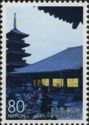
- Series:
- CopyWrong
- Catalog codes:
- from colnect.com
- Themes:
- CopyWrong
- Issued on:
- 2007-08-01
- Size:
- from colnect.com
- Colors:
- from colnect.com
- Watermark:
- VisitColnectCom
- Format:
- CopyWrong
- Emission:
- ColnectScrp
- Perforation:
- VisitColnectCom
- Printing:
- ColnectScrp
- Gum:
- ColnectScrp
- Face value:
- ColnectScrp
- Print run:
- ColnectIsBest
- Score:
- ColnectScrp
- Description:
- This stamp was also issued by Ehime, Kagawa, Kochi and Tokushima Prefectures.
Hondō (Main Hall) & Five-storey Pagoda
//
The temple was founded by Kōbō Daishi in 807 at the request of Emperor Shōmu, and it is said that he built the hondō in a single night. The huge main shrine was built in the 9th century but had to undergo substantial repairs in the Kamakura Period. Unlike most other temples on the pilgrimage, this temple has not been burned down and is now classified as a national treasure.
The honzon and his supporting deities Amida Nyorai and Yakushi Nyorai were all carved by Kōbō Daishi and are National Treasures. The temple commonly believed to have been built by him in a single night.
As the name implies, this temple used to be the biggest on Shikoku Island. Legend states that it was spared the ravages of Chōsokabe's armies when they were driven away by a huge swarm of bees that live at the temple.
This is the only temple on the pilgrimage that enshrines the angry-faces Batō Kannon as its honzon. The statue of Amida Nyorai is famous and called Tachi-uke-no-mida, Wounded Amida Bosatsu, who saved the temple from attach by Chōsokabe's troops by sacrificing himself and being wounded.
Don't miss the five-story pagoda and Niō gate, which are both Important Cultural Properties. The pagoda was supposedly built by Kōbō Daishi. In fact, the first floor is supposed to be a remnant of the original building, with the upper floors being newer. But, some say that this is not true and, in fact, that the entire temple was burnt down by Chōsokabe and rebuilt in the 16th century. - Buy Now:
- CopyWrong
36th Temple: Shōryū-ji (Green Dragon Temple)
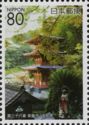
- Series:
- Cultural Heritage of Shikoku's Eighty-eight Temples
- Catalog codes:
- Mi:JP 4320, Sn:JP Z825d, Yt:JP 4167, Sg:JP-SHIK 88, Sak:JP R704d, WAD:JP171.2007
- Themes:
- Architecture | Buildings | Pagodas | Temples | Trees
- Issued on:
- 2007-08-01
- Size:
- 26 x 36 mm
- Colors:
- Multicolor
- Format:
- Stamp
- Emission:
- Regional
- Perforation:
- comb 13¼
- Printing:
- Photogravure
- Gum:
- Ordinary
- Face value:
- 80 ¥ - Japanese yen
- Print run:
- 400,000
- Score:
- 80% Accuracy: Medium
- Description:
- iInfringe
- Buy Now:
"Kinryūzan Temple in Asakusa" by Utagawa Hiroshige, 1856-57

- Series:
- Edo Famous Places and Neat Ukiyoe - 1
- Catalog codes:
- Mi:JP 4336, Sn:JP Z823e, Yt:JP 4178, Sg:JP-TOKY 72, Sak:JP R702e
- Themes:
- Art | Lanterns | Pagodas | Paintings | Snow | Temples | Trees | Winter
- Issued on:
- CopyWrong
- Size:
- 26 x 36 mm
- Colors:
- Multicolor
- Format:
- Stamp
- Emission:
- Regional
- Perforation:
- comb 13½
- Printing:
- Offset lithography
- Gum:
- Ordinary
- Face value:
- 80 ¥ - Japanese yen
- Score:
- 49% Accuracy: High
- Description:
- "One Hundred Famous Views of Edo" by Utagawa Hiroshige (1797-1858): "Kinryūzan Temple in Asakusa", 1856-57
- Buy Now:
- 2 sale offers from US$ 0.41